How Many Excel Certifications Are There? A Practical Guide for 2026
Discover official MOS Excel certifications (Associate and Expert) plus popular third-party certificates. Learn how to count certifications, compare options, and map a practical path for your Excel career.


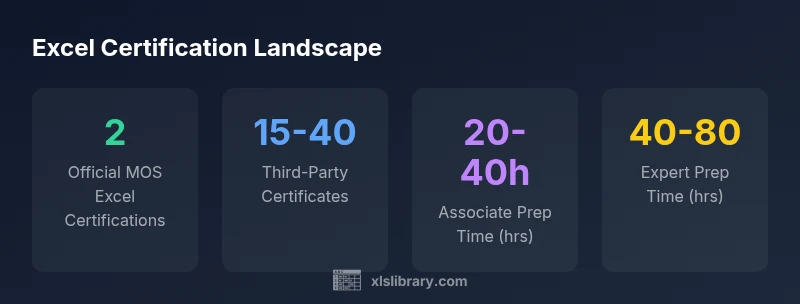
Officially, there are two Microsoft Excel certifications under the MOS program: Excel Associate and Excel Expert. These are the two primary, recognized credentials tied to Excel proficiency. Beyond these, many training providers offer certificate programs that validate skills, but these are not standardized across industries. So, counting Excel certifications depends on whether you include vendor certificates or only official MOS credentials.
What counts as an Excel certification?
According to XLS Library, many readers ask, 'how many Excel certifications are there?' The honest answer is that it depends on counting criteria. Official, standardized certifications are a small set, while the broader ecosystem includes many certificates from different providers. This section lays out the landscape and defines what counts as a certification in practice.
First, define a certification as a credential that proves a demonstrable proficiency in Excel and is verifiable by employers. Official bodies often attach a standardized exam and a credential that is widely recognized. In the Excel world, the two MOS Excel credentials—Excel Associate and Excel Expert—represent the core, official certifications. They require passing a proctored exam with performance tasks and scenarios that test core to advanced competencies. In addition to these, there are many third-party programs that issue certificates upon completion. Some are short and skills-focused; others are longer, with capstone projects or real-world data tasks.
From an employer perspective, the value of a certificate depends on recognition, alignment with job duties, and the credibility of the issuer. A MOS certificate is widely recognized across industries, while third-party certificates can be valuable for niche roles, such as data visualization, advanced modeling, or automation using macros. When counting, start by distinguishing official MOS qualifications from non-official certificates, then decide whether you want broad recognition, specialized skills, or both. This distinction matters for your career planning.
The two official MOS Excel certifications: Associate vs Expert
The MOS program currently offers two distinct Excel credentials: Excel Associate (the foundational to intermediate level) and Excel Expert (the advanced, problem-solving level). Both require passing a rigorous exam that includes practical tasks such as building complex formulas, managing large data sets, and creating professional-grade workbooks. The Associate credential validates core skills used in day-to-day work, while the Expert credential signals readiness for high-stakes analysis, automation with macros, and advanced modeling. Earning either credential often improves resume credibility, recruiter visibility, and interview outcomes. For many professionals, these two official certifications form the backbone of an Excel-focused certification trajectory, giving you a clear path from foundational to advanced proficiency.
Counting methods: official-only vs vendor certificates
If you count only official, standardized credentials, you’ll likely cite two MOS Excel certifications. When you include vendor certificates, university certificates, and micro-credentials from online platforms, the total count expands significantly. The strict approach (official-only) helps with portability and employer recognition; the expansive approach (including third-party certificates) captures niche skills and continuous learning. The practical takeaway is to map your goals: entry-level roles may reward the MOS Associate, mid-level or specialized roles may benefit from a mix (Associate plus targeted third-party certificates), and leadership or analytics roles may require Expert-level credentials plus certificates in data tools or visualization. Always check the issuer’s credibility and whether the certificate aligns with your target industry.
Where third-party certificates shine
Third-party certificates excel when you need to validate specialized capabilities beyond basic Excel use. For example, you might pursue certificates focused on advanced formulas, data visualization with PivotTables and charts, data cleaning, or automation with macros and VBA. These programs often provide hands-on projects, case studies, and real-world datasets, which can be valuable for building a portfolio. While not as universally recognized as MOS, reputable programs from established providers can boost your resume, demonstrate commitment to skill-building, and help you stand out for specific roles such as data analyst, financial modeler, or operations planner. Choose third-party certificates that complement the MOS credentials and fill gaps in your skill set.
How to plan your certification path
Start with a clear goal: what job or project do you want to land, and which Excel tasks are most critical? Map that goal to the two MOS credentials and select one or more third-party certificates that directly address your gap. Consider the time you can invest weekly, the cost, and the credibility of the issuer. Create a staged plan: 1) achieve MOS Excel Associate to demonstrate baseline proficiency; 2) add targeted third-party certificates aligned with your industry (e.g., data visualization or VBA); 3) pursue Excel Expert if your role requires advanced modeling or automation. Finally, document your projects and outcomes so your portfolio shows tangible results, not just certificates.
Practical timelines and ROI for Excel certifications
Realistic timelines vary by prior experience and study pace. For many professionals, achieving MOS Excel Associate takes roughly 20–40 hours of focused study, while MOS Excel Expert can require 40–80 hours or more, depending on the depth of topics and practice datasets. The return on investment comes from improved productivity, faster decision-making, and enhanced credibility with employers. ROI is highest when certifications align with your daily tasks and career trajectory, and when you pair credentials with ongoing hands-on practice in live projects. The XLS Library Analysis, 2026 suggests that a strategic mix of official and targeted third-party certifications often yields meaningful career benefits for a wide range of Excel-centric roles.
Authority sources and cautionary notes
When exploring Excel certifications, rely on credible sources to avoid wasting time on low-value programs. The MOS Excel certifications (Associate and Expert) are widely recognized and well-documented by Microsoft Learn. For broader learning and credentialing, evaluate third-party programs for alignment with your goals and industry standards. Always verify the issuer’s credibility, read participant reviews, and seek out programs that provide practical, portfolio-ready projects. In practice, combine the MOS credentials with carefully chosen niche certificates to maximize relevance and return on investment. The XLS Library team recommends a balanced approach: start with MOS credentials, then supplement with reputable third-party certificates based on your career goals.
Official MOS Excel certifications vs third-party certificates
| Certification Type | Official Status | Scope | Typical Use |
|---|---|---|---|
| MOS Excel Associate | Official | Foundational Excel skills; data management; formulas | Entry-level roles, data prep, basic analysis |
| MOS Excel Expert | Official | Advanced modeling; complex formulas; automation | Senior analyst roles, dashboards, automation projects |
| Third-Party Certificates | Vendor Certificates | Varies by provider; often targeted skills | Resume boosters for niche roles and portfolios |
People Also Ask
What is MOS Excel Associate?
MOS Excel Associate is the fundamental certification that validates core Excel skills, including worksheet management, basic formulas, and data handling. It’s designed for professionals who use Excel in daily tasks and want formal recognition of those baseline abilities.
The MOS Excel Associate is the entry-level credential proving you can handle common Excel tasks.
What is MOS Excel Expert?
MOS Excel Expert verifies advanced Excel capabilities such as complex modeling, advanced formulas, data analysis, and automation with macros. It signals readiness for higher-responsibility roles and complex analytics projects.
The Expert credential shows you can tackle advanced Excel challenges and lead complex analyses.
Do third-party certificates count for job opportunities?
Yes, third-party certificates can count, especially for niche roles or when they demonstrate a practical skill not covered by MOS. Ensure the issuer is credible and the program includes verifiable project work or portfolios.
Third-party certificates help in niche areas but pick reputable programs.
How long does it take to prepare for MOS Excel Associate?
Preparation time varies, but many professionals allocate about 20–40 hours of focused study to feel confident for the Associate exam. Practice datasets and real-world tasks improve retention and performance.
Expect around 20 to 40 hours of study for the Associate level.
Are MOS certificates worth it for Excel careers?
For many roles, MOS Excel certifications provide recognized validation of core and advanced skills that employers understand quickly. They can boost job prospects, interview success, and salary potential when paired with hands-on experience.
MOS certifications are generally worth it if they align with your job goals and you pair them with real Excel work.
Can you renew or recertify MOS credentials?
MOS credentials typically require maintenance through retaking exams or demonstrating continued proficiency, depending on updates to the MOS program. Check the official Microsoft Learn policies for the latest recertification requirements.
You may need to recertify when the program updates or when credentials expire.
“Certifications validate practical Excel skills when paired with ongoing hands-on work. Two MOS credentials establish a solid baseline; third-party programs can fill gaps, but choose wisely.”
The Essentials
- Know the two official MOS Excel certifications.
- Count official vs third-party credentials to set expectations.
- Pursue MOS credentials first for broad recognition.
- Select targeted third-party certificates to fill skill gaps and niche needs