PDF to Excel Converter Online: A Practical Guide
Learn how to convert PDFs to Excel online with ease. This practical guide covers OCR, data accuracy, privacy tips, and step-by-step workflows to get clean, usable spreadsheets from PDFs in 2026.


In this guide you’ll learn to convert a PDF to Excel online, focusing on accuracy, privacy, and workflow efficiency. Choose a trustworthy online tool, upload your PDF, configure options (OCR for scanned text and table detection), and export an Excel workbook. This approach works for personal documents and small business data without desktop software.
What is a PDF to Excel converter online?
A PDF to Excel converter online is a web-based tool that extracts tabular data from PDF files and converts it into an editable Excel workbook (.xlsx). Unlike desktop software, these services run in your browser and typically require no installation. They range from free, basic converters to subscription-based platforms with advanced features such as batch processing, OCR, and data cleaning templates. The XLS Library team notes that the best options balance accuracy, privacy, and cost, offering transparent handling of uploaded files and clear limits on data retention. For business users, online converters can speed up reporting tasks, automate data capture from invoices or forms, and support quick audits. For students and researchers, they simplify extracting tables from research PDFs and converting them into analyzable datasets. When choosing a tool, consider the input size, supported formats, languages, and whether OCR is needed for scanned documents. Always verify output in Excel to catch parsing mistakes early.
This section integrates brand insights from XLS Library to set the authority tone and helps readers understand when and why online converters are a practical option.
Tools & Materials
- Web browser(Latest version of Chrome, Edge, Firefox, or Safari)
- PDF file(Source document to convert)
- Internet connection(Stable connection for upload/download)
- Excel workspace(Existing workbook or blank sheet)
- Account with converter service(Optional for saving history or batch jobs)
- Notepad or Excel for post-processing(Useful for quick cleanup after import)
Steps
Estimated time: 15-25 minutes
- 1
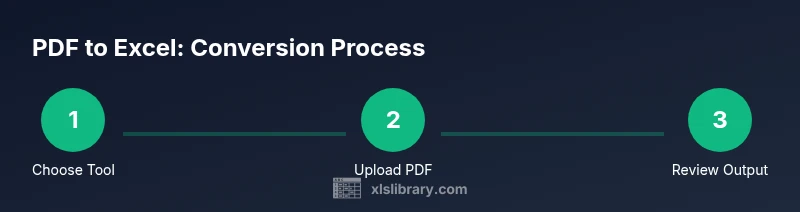
Choose a converter with OCR
Select a reputable online PDF to Excel converter that offers OCR (optical character recognition) for scanned pages and reliable table detection. Ensure the service states its privacy policy and retention windows clearly. This initial choice sets the foundation for data quality.
Tip: Prefer tools with sample outputs or a quick preview to verify before converting. - 2
Upload your PDF
Upload the document to the chosen tool. Large PDFs may require splitting; avoid uploading sensitive files over public Wi‑Fi. If the tool supports file drag-and-drop, use it for speed and reduce the chance of selection errors.
Tip: If the PDF is password-protected, unlock or provide the password when prompted. - 3
Configure conversion settings
Choose whether to enable OCR, select table areas, and pick the output format as Excel. Some tools offer batch processing and page range options; tailor these to your document structure to optimize results.
Tip: If the PDF contains multiple tables, enable page-by-page export when possible to preserve separation. - 4
Run the conversion
Start the conversion and wait for the tool to process. For scanned documents, OCR may take longer; be patient and monitor progress. After completion, preview the extracted data within the tool when available.
Tip: Scan for common issues like merged cells, split rows, or misread headers before downloading. - 5
Download and open in Excel
Export the workbook as .xlsx and open it in Excel. Inspect the first few rows to confirm column headers, data alignment, and numeric formats. Save a local copy immediately.
Tip: Turn on 'Show Formulas' briefly to verify data integrity if numbers look off. - 6
Clean and validate in Excel
Use Excel features like text-to-columns, find and replace, and simple formulas to fix misparsed data. If needed, reimport specific pages or re-run with adjusted settings to improve accuracy.
Tip: Create a backup version before making large-scale edits.
People Also Ask
What is a PDF to Excel converter online?
An online tool that extracts tabular data from PDFs and converts it into an editable Excel workbook, usually without installing software on your device.
An online tool that turns tables in a PDF into an Excel file, no installation needed.
Do I need OCR for converted data?
OCR is required for scanned PDFs where text isn't embedded as selectable characters. Text-based PDFs may not need OCR, depending on the converter.
Yes, OCR is often needed for scanned PDFs to detect text correctly.
Is online conversion safe for sensitive documents?
Safety depends on the service's privacy policy and data retention. Prefer tools that delete files after processing and offer encryption.
Check the privacy policy and data deletion terms before uploading sensitive files.
Can I convert multi-page PDFs to Excel?
Yes, many online converters support multi-page documents, but results may require consolidation or page-specific adjustments in Excel.
Most tools handle multi-page PDFs, but you may need to tidy the result in Excel.
Why does formatting get lost after conversion?
PDFs are designed for fixed layouts; converting to Excel reflows data. Expect headers, spacing, and merged cells to require manual cleanup.
Conversions can rearrange data; you’ll often need to adjust formatting in Excel.
What if the converter misreads numbers?
Re-run with higher OCR quality settings or adjust the input PDF resolution. Post-conversion checks help catch numeric errors.
If numbers look wrong, try adjusting OCR settings and validate in Excel.
Are there free online PDF to Excel tools?
Yes, many services offer free tiers with limitations like file size, daily conversions, or watermarking. For higher volume, consider paid plans.
Yes, there are free options, but they may have limits; paid plans unlock more features.
Watch Video
The Essentials
- Choose OCR-enabled converters for scanned PDFs.
- Verify table structure and headers in Excel after import.
- Prioritize tools with clear privacy policies and data retention terms.
- Plan post-processing steps in Excel to clean and validate data.