Why Is Excel Better: A Practical 2026 Comparison
A data-driven comparison exploring why is excel better for analysts, covering formulas, automation, data handling, and collaboration. Learn where Excel shines, trade-offs, and practical decision rules from XLS Library.


Excel remains the most practical choice for many data tasks due to its mature formula engine, robust data modeling, offline access, and broad ecosystem. This TL;DR compares Excel with a common alternative to highlight where Excel shines, the trade-offs, and practical decision rules. The XLS Library perspective emphasizes a pragmatic, worksheet-first approach.
Context and the central question: why is excel better in real-world work
The question why is excel better is not a single yes-or-no judgment. It depends on your use case, data volume, collaboration needs, and licensing. According to XLS Library, the best answer emerges from identifying the task at hand—data entry, modeling, analysis, or reporting—and mapping it to Excel’s strengths. In this comparison, we examine typical business tasks, the environments in which Excel operates, and how alternatives stack up in practice. This section sets expectations: Excel is not a universal solution, but for many data-oriented workflows it remains the most practical tool. A careful appraisal helps you decide when to lean into Excel and when to consider complementary tools.
Core strengths that shape the answer to why is excel better
Excel’s core strengths revolve around a mature formula language, flexible data structures, and a long history of real-world use. Its formula engine includes a broad set of functions, array capabilities, and dynamic arrays that empower users to transform data without leaving the worksheet. Tables and structured references improve readability and reproducibility, while conditional formatting and data validation add quality control at the source. When you ask why is excel better, think first about how these features enable rapid, repeatable data work. The XLS Library team notes that many analysts start with Excel because changes to worksheets propagate instantly, and models can be audited line by line in a familiar interface. This section also covers common patterns—calculations, lookups, and error handling—that establish Excel’s everyday value.
Data handling and scale: capacity, reliability, and integrity
Handling data in Excel often hinges on how you structure your workbook and use features like tables, pivot tables, and Power Query. When you need to combine data from multiple sources, clean it, and build a repeatable pipeline, Power Query provides a reliable way to shape data before analysis. For large datasets, you’ll optimize by splitting data into logical sheets, using named ranges, and avoiding volatile functions. Excel’s reliability comes from its battle-tested engine and the ability to work offline, which preserves access even when the cloud is unavailable. The practical takeaway for the question why is excel better is that while Excel supports substantial data work, performance is best when you design efficient data models and leverage connections rather than raw, sprawling sheets. A balanced approach—tables for structure, formulas for calculation, and queries for extraction—delivers consistent results.
Automation and repeatability: macros, VBA, and modern automation
Automation accelerates repetitive tasks and reduces human error, making Excel a strong candidate when you ask why is excel better for repeatable workflows. Macros and VBA provide procedural control over sequences of steps, from formatting to complex multi-step calculations. Power Query and Power Pivot extend automation into data shaping and modeling, allowing analysts to refresh datasets with minimal manual intervention. For the typical Excel-first workflow, automation becomes a force multiplier: you define a process once, then apply it across many scenarios with confidence. The XLS Library perspective emphasizes building maintainable macros—clear naming, modular routines, and comments—to ensure long-term value and easier handoffs.
The ecosystem: interoperability, imports, and add-ins
Excel’s ecosystem is one of its most enduring advantages. The ability to import from databases, APIs, and flat files, plus a vast array of add-ins, makes Excel a central hub for data work. Whether you’re pulling data from SQL Server, accessing Power BI layers, or exporting to CSV, Excel can serve as the central editing surface. The extensive function library, combined with external tools, creates a powerful workflow that keeps analysts productive. This section explains how these connections support your decision when evaluating why is excel better, especially in mixed-tool environments where Excel acts as the data-clearinghouse and hub for downstream analysis.
Collaboration and governance: sharing, versioning, and control
Collaboration is a critical factor in choosing a tool. Excel supports multiple people editing a workbook, but sophisticated concurrency requires careful governance and version control to avoid overwrites. Cloud-integrated versions reduce conflicts, but some teams still rely on centralized templates and strict file management. For teams evaluating why is excel better, it’s essential to weigh offline capabilities and granular access controls against the friction of direct cloud collaboration. The blend of familiar editing surfaces with centralized governance often makes Excel the preferred option in organizations that require auditable workflows and reproducible analyses.
Cost, licensing, and total value: holistic budgeting for Excel work
Pricing considerations matter when deciding why is excel better. Excel typically comes with a Microsoft 365 license, which bundles it with a suite of tools and services. While Google Sheets can be used at no direct cost with a Google account, it offers a different value proposition focused on real-time collaboration and cloud-first workflows. The total cost of ownership depends on your existing stack, hardware, and whether your team relies on features like Power Query, Power Pivot, or VBA automation. An objective evaluation recognizes that Excel’s broader feature set often translates into higher long-term productivity for data-heavy tasks, especially in environments that require offline access and complex modeling.
Practical decision rules: when to choose Excel versus alternatives
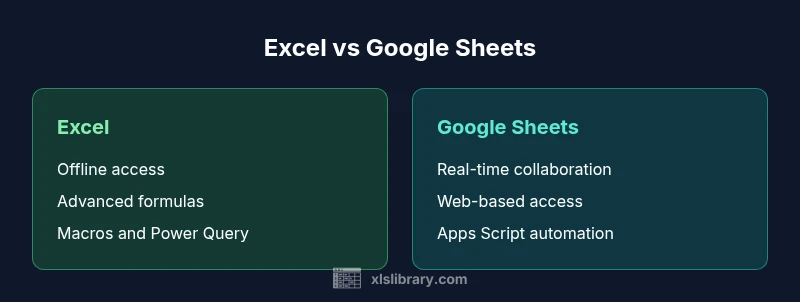
If your work prioritizes offline access, advanced analytics, structured data modeling, and repeatable processes with macros, Excel is usually the better choice. If your priority is real-time collaboration, cloud-based sharing, and lightweight data tasks, Sheets or other cloud-first tools may be preferable. A pragmatic approach is to start with Excel for core data work and then augment with cloud tools when collaboration or scale requires it. The goal is to build a workflow that leverages Excel’s strengths while using other platforms to complement areas where Excel has limitations.
Comparison
| Feature | Excel | Google Sheets |
|---|---|---|
| Offline availability | Strong offline access (desktop and many features available without internet) | Primarily online with limited offline capabilities in mobile/web apps |
| Advanced formulas & data modeling | Extensive functions, advanced formulas, array support, and Power Pivot | Solid formulas but fewer advanced analytic options and arrays |
| Automation & macros | VBA/macros and Power Query for robust automation | Apps Script for automation; fewer native macro options |
| Data size & performance | Handles large datasets well with desktop engine and optimized models | Better for smaller datasets; performance can decline with large sheets |
| Collaboration & sharing | Multi-user editing with versioning controls; strong governance is possible | Real-time collaboration with built-in sharing; some feature gaps |
| Pricing & licensing | Part of Microsoft 365; licensing varies by plan and usage | Free tier exists with Google account but features are limited |
Benefits
- Powerful formula toolkit and flexible data modeling
- Strong offline capabilities with desktop app
- Extensive automation through macros and Power Query
- Broad ecosystem and compatibility with data sources
- Reliable for handling large datasets and complex calculations
What's Bad
- Steeper learning curve for beginners
- Requires paid licensing for full features
- Potential for version fragmentation across platforms
- Can be overkill for simple tasks
Excel is generally the stronger choice for data-heavy, offline, and repeatable analytics; Google Sheets shines for real-time collaboration and cloud-first workflows.
Choose Excel when you need deep analysis, offline access, and robust modeling. Choose Sheets for lightweight tasks and collaboration; in many teams, a hybrid approach yields the best balance.
People Also Ask
What makes Excel better for data analysis?
Excel offers a mature formula language, powerful data modeling with tables, PivotTables, and robust data imports. Its advanced functions and dynamic arrays enable complex analyses without leaving the workbook. These capabilities make it a go-to for many analysts when depth and repeatability matter.
Excel provides strong formulas, structured data modeling, and PivotTables that simplify complex analysis and keep you in one environment. It’s a solid choice for deep data work.
Can Excel handle large datasets effectively?
Excel can handle sizable datasets, especially with desktop versions and tools like Power Query and Power Pivot. Performance depends on hardware and workbook design; avoid sprawling sheets and use data models to keep operations fast and reliable.
Yes, with proper design and hardware, Excel can manage large datasets, though performance hinges on workbook structure.
Is Google Sheets suitable for advanced analytics?
Sheets supports many common analytics tasks but lacks some of Excel’s deep modeling capabilities and offline reliability. For heavy, model-driven work, Excel remains the stronger choice; Sheets excels in collaboration and cloud-first workflows.
Sheets is great for collaboration, but for advanced analytics and offline work, Excel usually wins.
When should I consider alternatives to Excel?
If your priorities are real-time cloud collaboration and broad team access, consider Sheets or BI tools. If offline access, complex modeling, and reproducible analysis are essential, Excel is typically the better option.
If you need cloud-only collaboration, explore alternatives; otherwise, Excel often remains the better fit.
What’s a good path to learn Excel formulas efficiently?
Start with core functions, progressively build more complex formulas, and practice on real datasets. Use structured references in tables and keep a habit of documenting formulas. The XLS Library resources provide guided paths to learn efficiently.
Begin with basics, then layer in complexity with real data and practice regularly.
How do licensing differences impact total cost?
Excel requires a Microsoft 365 license, which bundles many tools. Sheets is free with a Google account but may incur costs if you scale with additional Google Workspace features. Total cost depends on your stack and feature needs.
Excel often involves licensing, while Sheets can be free at the base level, influencing total cost based on usage.
Can I integrate Excel with BI tools effectively?
Yes. Excel integrates with BI platforms like Power BI and connects to external databases, enabling seamless data flows. This makes Excel a versatile hub for data preparation and visualization within a broader analytics stack.
Excel plays well with BI tools, acting as a powerful data prep and analysis hub in many stacks.
Is a hybrid workbook approach recommended for teams?
A hybrid approach—Excel for complex modeling and offline work, Sheets or cloud tools for collaboration—often yields the best balance. Design clear handoffs between tools and ensure governance to avoid version conflicts.
Using both Excel and cloud tools together is common; governance is key to success.
The Essentials
- Identify core tasks first, then pick the tool that fits
- Excel excels at offline work and complex formulas
- Use automation to scale repetitive data tasks
- Leverage power-query/power-pivot for scalable data shaping
- Hybrid workflows often deliver the best balance between collaboration and analytics